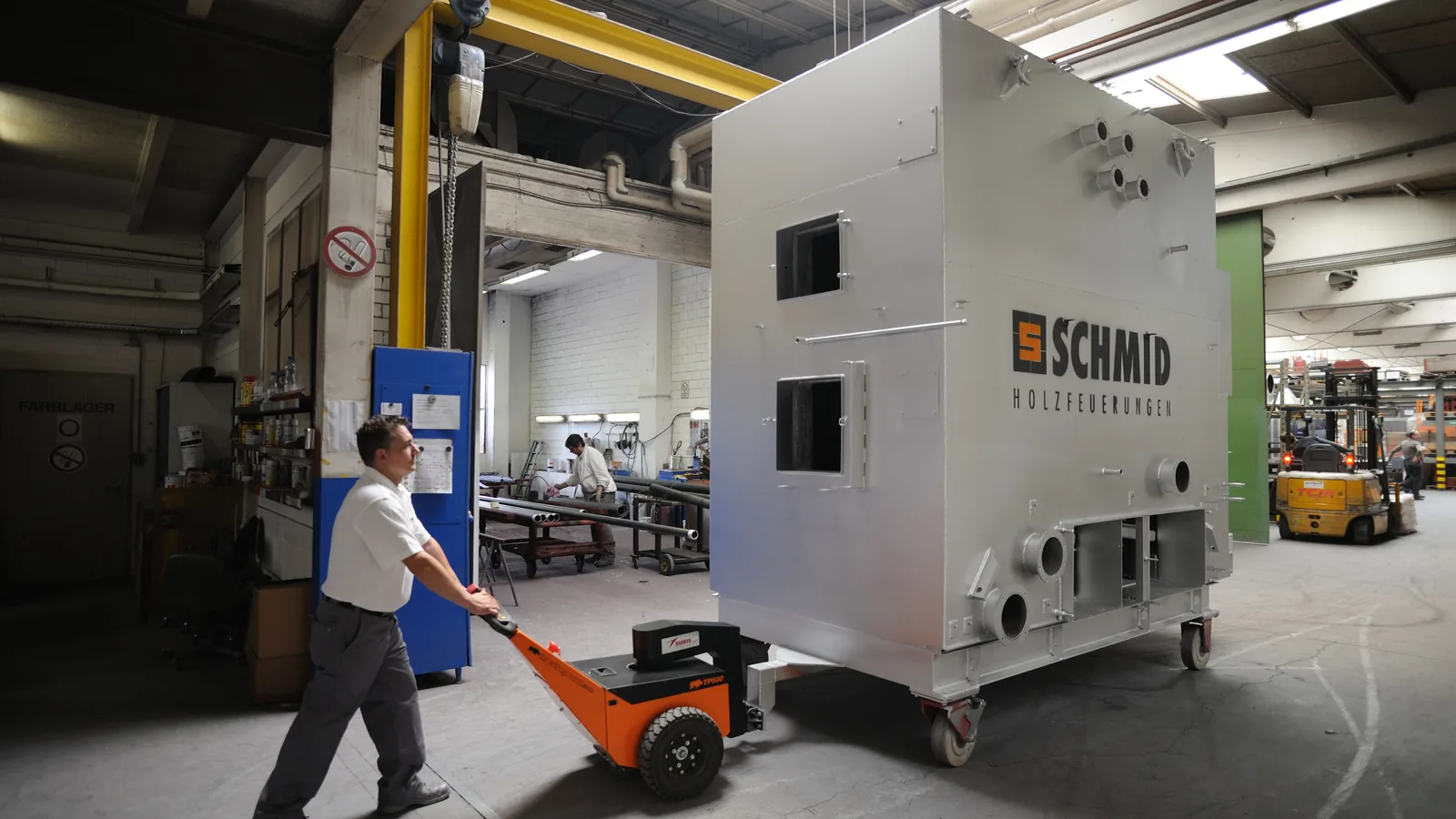
A forklift is the default answer to “how do we move that?” in most factories and warehouses. But if the load already sits on wheels or rails, a forklift is often the wrong tool. It lifts when you only need to push. This guide explains where each machine fits, so you can pick the right one for the job.
The short answer
Use a forklift when the load has to be lifted: off a lorry, onto racking, or from pallet to pallet. Use an electric tug when the load is already on castors, wheels or rails and only needs moving along the floor. That includes trolleys, roll cages, kiln cars, die carts, vehicles, bogies and production frames.
How they compare
| Electric tug | Forklift | |
|---|---|---|
| What it does | Pushes or pulls a wheeled or railed load | Lifts and carries a load on its forks |
| Who drives it | One pedestrian operator, walking behind | A trained, authorised driver, seated or standing on the truck |
| Training | Operator training on the machine, which we provide at handover | Basic, specific-job and familiarisation training to HSE’s L117 code of practice, typically a 3 to 5 day course |
| Space needed | A tug works in tight aisles, corridors and cells. The TT50 turns in a 1.4 m circle | Wide aisles and turning room for a counterbalance truck |
| Heaviest loads | From 1,000 kg on castors with a TT50 up to 300,000 kg on rails with a TP3000 | Limited by the truck’s rated lift capacity |
| Around people | Walking pace, with the operator beside the load | A segregated traffic route is usually needed |
Why a tug is often the better choice for wheeled loads
You don’t need a licensed driver
HSE expects every lift truck operator to be trained to the standards in its Rider-operated lift trucks code of practice (L117). That means basic training, training on the specific truck and supervised familiarisation, followed by monitoring and refresher training. A pedestrian electric tug still needs proper operator training, but it isn’t a lift truck. The people who already move the trolleys can usually be trained to use one.
It keeps the load on its own wheels
If a mould, a vehicle or a loaded trolley is designed to roll, lifting it adds risk and handling time. A tug couples to the load and moves it as it is. Our machines move loads up to 4,000 kg on castors with a single TP250, and up to 12,000 kg with a TP500.
It fits where a forklift can’t
Hospital corridors, food production cells, joinery lines and rail depots rarely have room for a forklift to turn. A pedestrian tug is narrow, works at walking pace and stops where the operator stops.
It frees the forklift for lifting
Many sites keep a forklift busy for jobs it was never needed for, such as shuttling trolleys between bays. Putting a tug on those moves leaves the forklift free for loading and racking.
When a forklift is still the right tool
- The load arrives on pallets and has to come off a vehicle.
- It has to go up into racking or onto a mezzanine.
- There are no wheels or rails under it, and fitting a trolley or skates isn’t practical.
Plenty of our customers run both. The forklift does the lifting and the tug does the moving.
Real example
At Sheffield Supertram’s depot, a TP3000 lines trams up over the wheel lathe with the tram powered down. The estimated saving is around £80,000 a year. Read the case study.
Not sure which you need?
Tell us what you’re moving, how heavy it gets and what it runs on. One of our engineers will recommend a machine and a coupling, or tell you if a forklift really is the better fit. Get in touch or call 01538 360372.